Sunday, August 2, 2020

Little offered Idahoans $100 million to return to work. Most of the money sat there. - bigcountrynewsconnection.com

BOISE — Idaho has paid out less than a quarter of the $100 million set aside by Gov. Brad Little to encourage laid-off Idahoans to return to work.
So far, $20.3 million has been issued by the Idaho Tax Commission in back-to-work bonuses, with an additional $2.1 million approved for distribution.
Last month, Little announced that the state would give up to $1,500 to full-time workers, those working at least 30 hours per week, to return to work. Employees who worked a minimum of 20 hours per week were offered up to $750. The entire program has $100 million available on a first-come, first-served basis.
The bonuses were given as bait to encourage workers earning $75,000 or less a year to get back to work, rather than continue drawing unemployment. The bonuses are paid after a worker has put in four weeks of work after returning to work between May 1 and July 15.
“The Return-to-Work bonuses reflect Gov. Little’s belief that we want people working,” Marissa Morrison Hyer, Little’s press secretary, said in an email to the Idaho Statesman. “Idaho now ranks in the top three states nationally for lowest unemployment and first in the nation in economic momentum during the COVID-19 months. Idaho’s strong economic rebound is the result of the foresighted stimulus efforts and the great work Idaho businesses have done in re-opening safely.”
Little created the bonuses using part of the $1.25 billion he received for state and local use under the $2.2 trillion coronavirus relief law Congress passed in March.
He created the bonuses to counter the $600 weekly federal supplements to Idaho’s unemployment compensation that Congress authorized in that same law. Those supplements gave laid-off people an incentive not to return to work, the governor said in an interview this week.
“In an ideal world, if I was crafting everything, I wouldn’t have to do the back-to-work,” Little said. “Congress would have created a better incentive for people to go back to work.”
He said Congress created a cookie-cutter approach that applied the same to someone in Manhattan, where it’s very expensive to live, and to someone in Aberdeen, Idaho, where the cost of living is much less.
“What we need is some kind of incentive for people go back to work,” Little said. “And everybody, even the proponents of it, said in some areas, it was a disincentive for people to go back to work.”
So far, 3,956 employers, representing 23,346 workers, have taken the governor up on his offer. Nearly 15,100 workers have had payments issued, with 1,573 more approved for payment, leaving 6,706 in review, according to a report from the Idaho Tax Commission.
It’s unclear why more employers did not take the offer. While most businesses have reopened, restaurants are unable to serve as many customers while maintaining social distancing, and hotels and other businesses dependent upon tourists have not seen business return to the same levels as in summers past.
Calls to the Idaho Associated General Contractors, the Idaho Lodging and Restaurant Association and the Idaho Retailers Association were not returned.
Little and the Coronavirus Financial Advisory Committee will determine how best to use any leftover money, Morrison Hyer said. “The governor has stated that any unspent money at the end of the year would likely go to the unemployment insurance trust fund,” she said.
Idaho’s unemployment rate ballooned to 11.8% in April, with more than 100,000 people out of work. It improved to 9% in May and 5.6% in June, according to the U.S. Bureau of Labor Statistics.
The sooner they returned to work, the bigger the bonus workers were offered. Full-time employees who came back to work from May 1 to July 1 could earn the full $1,500. Those returning to work July 2 to 8 were eligible for $1,000, while those starting back to work July 9 to 15 could receive $500.
In those same time periods, part-time workers could earn $750, $500 or $250.
Forty percent of the payments that have been approved or are in the pipeline are for people employed at restaurants, hotels, and the health-care and-social assistance sectors, according to the tax commission. They are slated to share in $12.3 million.
Store clerks and other retail workers put in claims totaling $4.9 million. Manufacturing employees put in for $4.1 million.
Eighty percent of the claims, 18,748, were submitted in the first five days of the program, between July 13 and July 17.
Payments are being made within about a week after the application is approved.
For those still out of work, the $600 a week supplemental unemployment benefit provided by the federal government is scheduled to end at the end of the week.
In May, the Democratic-led House passed an extension that would continue the $600 payment through the end of the year. Republicans and the White House oppose maintaining the $600 level, saying it discourages people from going back to work.
GOP senators suggested lowering it to $200 a week through September, according to the $1 trillion HEALS Act proposed on Monday. In October, the payment would rise to as much as $500 a week that when combined with state unemployment payments would give workers 70% of their working salaries.
The $600 supplements expired Saturday.
The Link LonkAugust 02, 2020 at 09:00PM
https://www.bigcountrynewsconnection.com/news/state/idaho/little-offered-idahoans-100-million-to-return-to-work-most-of-the-money-sat-there/article_97e6233c-cb19-518a-b944-3f2418a0e05b.html
Little offered Idahoans $100 million to return to work. Most of the money sat there. - bigcountrynewsconnection.com
https://news.google.com/search?q=little&hl=en-US&gl=US&ceid=US:en
Little, Robert C. - Greensboro News & Record
[unable to retrieve full-text content]
Little, Robert C. Greensboro News & Record The Link LonkAugust 02, 2020 at 11:00AM
https://greensboro.com/obituaries/little-robert-c/article_21a2d6c1-df68-5d4a-a24e-c91896d9bc42.html
Little, Robert C. - Greensboro News & Record
https://news.google.com/search?q=little&hl=en-US&gl=US&ceid=US:en
Saturday, August 1, 2020
For Vikings, so much to do and so little time to do it at training camp - Minneapolis Star Tribune

The 60th training camp in Vikings history officially began more than a week ago. On Monday, as players are allowed to congregate on the field for the first time, it’s hardly a stretch to say the 2020 camp already ranks as one of the strangest in team history.
The Vikings placed eight players, including Pro Bowl linebacker Anthony Barr and first-round pick Justin Jefferson, on the NFL’s COVID-19 reserve list last week, after head athletic trainer and team infection control officer Eric Sugarman tested positive for the coronavirus himself. The total was near the top of the NFL after the first week of testing.
As the Vikings wait to get some of the group back, their healthy players will begin on-field preparation, with no fans in the training camp stands, for a season that will include no dress rehearsals.
This season will be the first in Vikings history without a preseason, thanks to an agreement between the league and NFL Players Association that eliminated exhibition games in the midst of the pandemic. If the league makes it to opening day, the first test for the Vikings’ reworked defense will be Aaron Rodgers, in a building with only a smattering of fans.
As the NFL heads into the 2020 season with coronavirus tests and crossed fingers, here’s a look at what to expect from a surreal Vikings training camp.
Testing and tracing a fact of life
All Vikings players who cleared the NFL’s initial set of coronavirus screenings — with three negative tests in four days before being allowed to enter the team’s practice facility — will be subject to daily COVID-19 tests for at least two weeks. If the positive test rate falls below 5% for all team personnel after two weeks, the Vikings can scale back to tests every other day. Test results are expected in 24 hours.
All team personnel are also wearing contact tracing monitors designed to help the Vikings isolate anyone who might have come in close contact with someone who tested positive.
Conditioning this week, practices next week
Even though NFL teams can get on the field Monday, they still won’t begin practicing until Aug. 12. They’ll spend the first segment of training camp in an eight-day conditioning period (with a mandatory day off next Saturday), to help replace a fraction of the training they lost with facilities closed and offseason programs canceled this spring.
By gradually bringing players back onto the field, the league and union hope to avoid a rash of soft-tissue injuries (such as hamstring and groin strains) that could come with an abrupt return to practices.
Players can spend 60 minutes in the weight room and do 60 minutes of on-field conditioning from Monday through Aug. 11. Teams can also have 60-minute walk-throughs during the first four days of the conditioning period, and 75-minute walk-throughs during the last four days.
Opt-out deadline still looming
Even though players can start working out this week, they’ve still got time to opt out of the 2020 season; the deadline for players to opt out is a week after the league and union sign their agreement about how the 2020 season will operate, though the league was reportedly seeking to move the deadline to the middle of this week. Players deemed to be high risk because of pre-existing medical conditions can collect a $350,000 payment for the 2020 season. Low-risk players receive a $150,000 advance on their base salary, with the remainder of their base salary pushed into 2021. The contracts of all players who opt out of the 2020 season (like Vikings nose tackle Michael Pierce) will roll over into 2021.
Practices: Lots to do in little time
A flurry of offseason moves means the Vikings will have at least four new starters on defense, including perhaps their youngest cornerback group in Mike Zimmer’s seven seasons as head coach. With no preseason games, the Vikings will have to operate on a truncated timetable.
“We’re going to have to set up situations throughout practice where we’re, number one, we’re going to have live contact,” Zimmer said on July 25. “We’re going to have to evaluate guys with some of our younger guys against our better guys and try to evaluate those players in those situations, so the evaluation part will probably be the biggest thing for a lot of these young guys.”
Whatever the Vikings do, they’ll have to work within tighter constraints than usual: Their first practice on Aug. 12 will be capped at 90 minutes; they can’t put pads on until Aug. 17; and they can practice in pads only 14 times from Aug. 17-Sept. 6.
Defensive battles: Plenty of competition at corner
The Vikings’ secondary will be a major focus of attention during camp, with starting cornerback spots up for grabs among Mike Hughes, Holton Hill, Kris Boyd and such rookies as first-round pick Jeff Gladney and third-rounder Cameron Dantzler.
Zimmer has typically preferred to bring young corners along slowly, and said on July 25 the Vikings would still “have to start with the baby steps: footwork and hand placement and technique.”
If Gladney and Dantzler show they can pick up the particulars of Zimmer’s defense quickly, though, they could have opportunities to contribute.
On the defensive line, the Vikings will have to figure out a plan at nose tackle; they seemed likely this week to stick with younger players such as Jaleel Johnson and Armon Watts, rather than pursuing a veteran, after Pierce opted out of the season.
Rookie James Lynch could make a quick impact as an interior pass rusher, and the Vikings will see if rookie D.J. Wonnum and free-agent pickup Anthony Zettel can replenish their depth behind Danielle Hunter and Ifeadi Odenigbo at defensive end.
Offensive battles: Interior line needs to be sorted out
The Vikings’ lack of cap space this offseason meant they had few resources to improve their offensive line in free agency, and while second-round pick Ezra Cleveland could be the left tackle of the future, it’s difficult to project whether he’ll be ready to take on the starting job with only a few weeks of work in training camp.
That means if Riley Reiff stays at left tackle, the Vikings still need to figure out both of their guard spots, after cutting Josh Kline for cap reasons in March. Roster uncertainty could help Pat Elflein keep his spot, but second-year guard Dru Samia could push Elflein for a starting job. The Vikings will have to find another starter from the group of Dakota Dozier, Aviante Collins and Brett Jones, or potentially look at finding a veteran.
Their group of wide receivers will have a different look, too, with Jefferson on the COVID-19 reserve list and Stefon Diggs in Buffalo. Free-agent addition Tajae Sharpe and second-year man Bisi Johnson will get plenty of time to work alongside Adam Thielen, but the Vikings could use Jefferson’s potential for dynamism if he’s able to get healthy relatively soon. Chad Beebe has shown signs he can be effective, but he’ll have to stay healthy in Year 3 to make the team.
The Link LonkAugust 02, 2020 at 08:08AM
https://www.startribune.com/for-vikings-so-much-to-do-and-so-little-time-to-do-it-at-training-camp/571983092/
For Vikings, so much to do and so little time to do it at training camp - Minneapolis Star Tribune
https://news.google.com/search?q=little&hl=en-US&gl=US&ceid=US:en
Mike and Jessica Trout's first little Angel is Beckham Aaron - Los Angeles Times

Three-time American League most valuable player Mike Trout is now a first-time dad.
The Angels center fielder and his wife, Jessica, announced the birth of their first child Saturday, a boy named Beckham Aaron Trout.
“Our greatest gift from above,” Mike Trout wrote on his Twitter account while posting a photo of Beckham. “We are so in love!”
The baby was born Thursday afternoon and weighed in at 7 pounds, 10 ounces. Little Beckham’s middle name is undoubtedly a tribute to Aaron Cox, Jessica’s brother and Mike’s good friend, who died in 2018.
Trout, who turns 28 this month, left the Angels on Thursday and was placed on the paternity list, which allows players to stay away from their teams for three days. Angels manager Joe Maddon said he believes Trout will return to the Angels shortly, but the team won’t rush him.
The Link LonkAugust 02, 2020 at 06:45AM
https://www.latimes.com/sports/angels/story/2020-08-01/mike-trout-jessica-first-little-angel-baby-boy-beckham-aaron
Mike and Jessica Trout's first little Angel is Beckham Aaron - Los Angeles Times
https://news.google.com/search?q=little&hl=en-US&gl=US&ceid=US:en
“Bluey,” the Coronavirus, and the Weirdness of Little Kids - The New Yorker

Early in the COVID-19 lockdown, when I was still ambitious about finding creative ways to entertain a toddler, my two-and-half-year-old daughter and I did an arts-and-crafts project, making “dragons” out of paper-towel tubes. We drew eyes and teeth on the cardboard tubes—the hole at one end was the mouth—and used pipe cleaners to give them spines and legs. It was a huge success. My daughter loved the paper-towel-tube dragons. They quickly joined her favorite toys, a set of plastic “Peppa Pig” figurines. She pretended that one of the “Peppa Pig” characters, Miss Rabbit, was a dragon trainer, flying around on the dragons’ backs. One day, she seemed to get an idea. She stood a paper-towel-tube dragon vertically, on its tail, and arranged Miss Rabbit in a sitting position on the hole that was its mouth. Then she made a sh-h-h sound and exclaimed, “Oh, no! Miss Rabbit peed in her dragon!”
I wasn’t sure how to respond. We had recently started potty-training her: this announcement was clearly about that. I didn’t want to shame her. But I was also grossed out. After gathering my thoughts, I addressed the plastic bunny in a bright, helpful voice: “Miss Rabbit, it’s great that you want to use the potty. But it’s not nice to pee in your dragon. He’s your friend. Why don’t you pee in a regular paper-towel tube?”
My daughter thought that this was hilarious. She immediately wanted to perform the entire drama—Miss Rabbit’s dragon-riding, the peeing, the scolding—all over again. Miss Rabbit Pees in Her Dragon joined the pantheon of her favorite games, along with Ambulance and Birthday Party. When my partner finished his morning Zoom calls and came downstairs for the child-care hand-off, he’d ask, “How’s Miss Rabbit? Did she pee in her dragon again?” And then he’d have to play it, too.
I’m not the first person to note that, for all the pain this pandemic has inflicted on working parents, the COVID-19 lockdowns have given us something remarkable: hours and hours of unstructured playtime with our children. I’d thought that I was getting this before—on weekends and in the harried hours between dinner and bedtime—but, in retrospect, that was nothing. In the three-plus months that my partner and I spent trapped in the house with our daughter, sharing child-care duties, I’m pretty sure that we had our brains rearranged. Time began to unfurl in a slow, trippy way that I hadn’t experienced since childhood. Our home became an extension of a two-year-old’s fantasy life, a place where hazy ideas about the outside world mingled with animal facts, domestic rituals, and scenes from her favorite cartoons.
Those cartoons include “Peppa Pig,” of course, and, these days, an equally charming show by the same creators, “Ben & Holly’s Little Kingdom.” But my favorite—and the most relevant to our current predicament—is “Bluey,” an Australian series featuring a family of anthropomorphic heeler dogs—mother, father, two little girls—living in the lush suburbs of Brisbane. (Disney acquired most of the show’s international broadcast rights in 2019. Its second season premiered in the U.S. in July.) The show revolves around play. Many of its seven-to-eight-minute episodes center on a make-believe scenario that the kids, Bluey and Bingo, act out, often with their parents as supporting characters. Although the kids are older than my daughter, their games bear a recognizable weirdness: in Yoga Ball, they put a shawl and sun hat on a yoga ball and pretend that it’s a fancy lady. In Asparagus, a piece of asparagus becomes a magic wand that can transform family members into wild animals. The episode culminates in an especially hilarious sequence where Bingo and her mother become lions and stalk their next-door neighbor as he’s hanging up his laundry.
Not surprisingly, the show is based on real games that its creator, Joe Brumm, played with his two young daughters. In a Zoom conversation, Brumm told me that he wanted to capture “the real, idiosyncratic way that kids play”—as opposed to the way that we adults imagine them playing: running around and shouting “Tag!,” perhaps, or quizzing themselves on the ABCs. The idea came to him during early-morning play sessions, while his wife was sleeping. “You’d find yourself in these bizarre, Monty Python-esque scenarios,” he said. “You know, it’s five in the morning, and, suddenly, you’re in their café, handing them money, and they’re handing you money back. And I just thought, This is funny.”
Brumm pointed out that there is an “inherent comedy” in the way that kids play, because, frequently, their games are earnest attempts to re-create both their own lives and the adult world. But their knowledge of the world is limited—so they improvise. “When they get to a bit they don’t understand, they just substitute something from their imagination to kind of smooth it over,” Brumm said. (As a writer, he is attuned to the language of this imagination, especially when it comes to making up names: Slobber Dobber, Sharalanda, Boop Boop Bop Boop.) In an episode called “The Doctor,” Bingo plays a doctor, and Bluey plays a medical receptionist. Their friends present themselves with a parade of imaginary maladies: scorpion bites; arms fallen off; “I accidentally ate a hippopotamus. And now, when I burp, I burp out baby hippopotamuses.” These are treated as normal ailments, with the doctor pronouncing, “Don’t worry, we’ll get you fixed in a jiffy!” and the receptionist passing out lollipops. “These are the things which adults find funny,” Brumm said. “And to me, it’s endlessly fascinating because it’s the essence of a trip to the doctor’s office. It’s not all the details, but it’s the important stuff. And it makes you see it fresh.”
Brumm researched the psychology of play and learned about its role in early-childhood development—especially the way that it teaches children to navigate social life. Frequently, the kids on “Bluey” will be playing a game when they come to a point of contention: in “Grannies,” they’re pretending to be old ladies when they get into an argument about whether grannies can perform a dance move known as the floss. In “Hotel,” Bluey wants Bingo to play a “crazy hotel helper,” but Bingo wants to be a “crazy pillow.” They have to resolve their differences to continue the game. Brumm explained, “That process, being able to have a debate with another kid and come to an agreement—doing that day in, day out, from age three to five, is how they end up getting socialized. It’s really lovely, because they do it naturally. You don’t have to step in and say, ‘Hey, you need to get along.’ ”
On the show, the parents do sometimes nudge the kids in the right direction. In “Grannies,” Chilli, Bluey’s mother, tells her, “You’re going to have to decide: Do you want to be right, or do you want Bingo to keep playing with you?” Bluey thinks about it and asks, “Can I have both?”—to which her parents respond, “No!” Each episode of “Bluey” generally culminates in a mild life lesson. Moralizing is avoided. Brumm said that he’s drawn to insights that are “quite counterintuitive.” In “The Claw,” Bandit, Bluey’s father, pretends to be an arcade game, and he attempts to teach the kids a lesson about the perils of gambling. It backfires, and they end up pelting him with stuffed toys. “Did we learn anything today?” Chilli asks, later. “Yes,” Bandit says. “These kids are awesome.”
It’s interesting to think about how COVID-19 has affected the learning process depicted in “Bluey.” Over the last few months, my daughter has been deprived of playmates her own age. But we’ve had a good time together. And her father and I have discovered our inner two-year-olds. Brumm admitted, somewhat guiltily, that the lockdown at their home in Brisbane had been idyllic. “It was a lot like what I imagined the nineteen-fifties to be like, but with more iPads,” he said. They wrote letters to the elderly people who lived on their street and placed them in mailboxes. “The kids were in the garden a lot. They were playing with each other. They were watching cocoons hatch and finding dead birds in the pool.” (The dead bird turned out to be a live bush rat.) Like other parents, he looked on with awe as the kids adapted to a drastically altered world, integrating the language of hygiene and social distancing into their games. They’d be playing with dolls, whom they called their daughters. “The daughters would be coming over for playdates, and it would be, like, ‘O.K., everyone, make sure you sit six feet apart. And you have to wash your hands!’ ”
Was there a lesson in this? Brumm mused, “One of them is that kids don’t need a great deal. You know? All these things we kept thinking were essential”—shopping excursions, playdates, field trips to cultural institutions—“once that was taken off the table, they just got on with it, and they were happy.” This lesson sounded like the kind of thing that could make into an episode of “Bluey.” But Brumm said that the pandemic would not be making an appearance in a future season. “You know what? Whilst there have been a lot of positives, I bloody hate this thing. And once they get rid of it, I don’t think I want to talk about it again.”
August 01, 2020 at 05:02PM
https://www.newyorker.com/culture/on-television/bluey-the-coronavirus-and-the-weirdness-of-little-kids
“Bluey,” the Coronavirus, and the Weirdness of Little Kids - The New Yorker
https://news.google.com/search?q=little&hl=en-US&gl=US&ceid=US:en
Meteorologists: Hurricane Isaias Getting ‘A Little Stronger’ - Voice of America

The U.S. National Hurricane Center said early Saturday that Hurricane Isaias is getting “a little stronger” as it drenches the Bahamas and makes its way toward the U.S. mainland.
Isaias is moving northwest with maximum sustained winds at 135 kph, according to meteorologists.
Isaias, located about 185 kilometers south southeast of Nassau, is expected to make landfall on Florida’s southeastern coast late Saturday or Sunday.
The southern U.S. states of Florida and North Carolina have declared hurricane warnings.
Florida Gov. Ron DeSantis has declared a state of emergency for a dozen counties on the Atlantic Coast. Heavy rains from the storm are expected to begin in Florida on Saturday and arrive over the Carolinas by early next week.
In North Carolina, Gov. Roy Cooper also declared emergencies in coastal counties and ordered the evacuation of Oracoke Island, which was hit by last year's Hurricane Dorian.
The hurricane has prompted authorities in parts of Florida to close coronavirus testing sites at a time when cases have been growing in the state.
Officials in Miami-Dade County said they do not believe it will be necessary to open evacuation centers for this storm but said 20 centers remain on standby in case conditions change.
In the Bahamas, officials evacuated people in Abaco and in the eastern end of Grand Bahama who have been living in temporary structures since Hurricane Dorian.
Earlier, while still a tropical storm, Isaias lashed Puerto Rico and the Dominican Republic, causing power outages and small landslides.
A man died in the Dominican Republic when he was electrocuted by a fallen electrical cable, according to the Associated Press.
U.S. President Donald Trump has signed an emergency declaration for Puerto Rico, which has yet to fully recover from 2017’s Hurricane Maria and a recent series of earthquakes.
Isaias is the ninth named storm of a busy Atlantic hurricane season. This is the earliest date a storm beginning with the letter “I” has formed.
August 01, 2020 at 03:15PM
https://www.voanews.com/usa/meteorologists-hurricane-isaias-getting-little-stronger
Meteorologists: Hurricane Isaias Getting ‘A Little Stronger’ - Voice of America
https://news.google.com/search?q=little&hl=en-US&gl=US&ceid=US:en
Featured Post
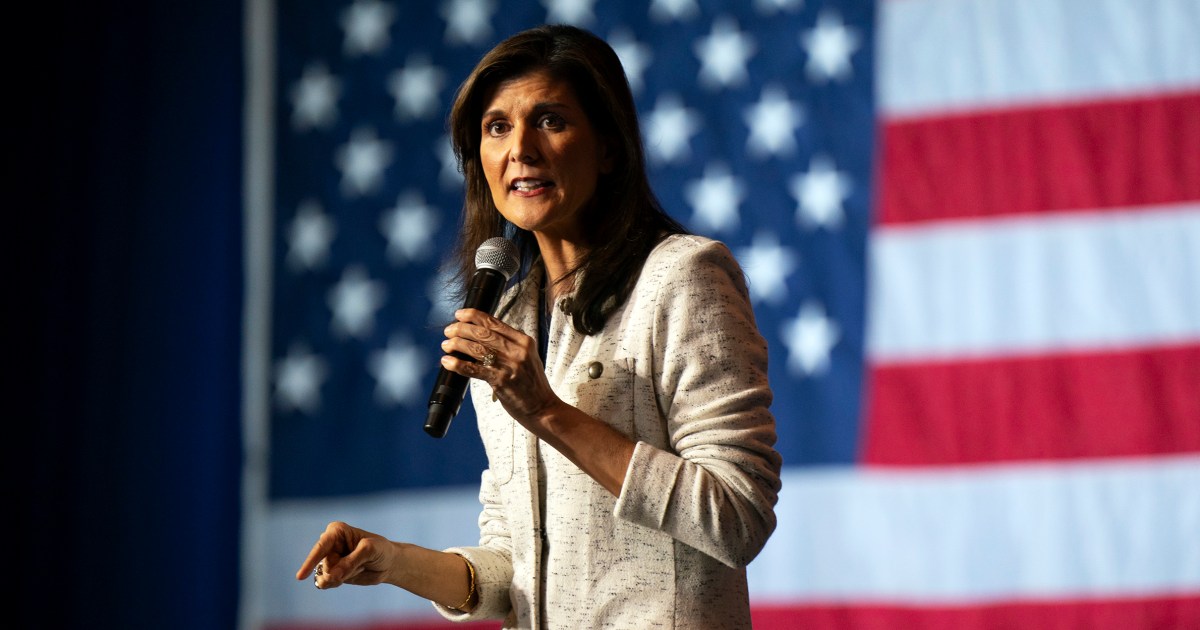
Nikki Haley's super PAC spent big to fuel her rise. It started 2024 with little left. - NBC News
little.indah.link The super PAC backing former U.N. Ambassador Nikki Haley entered the election year in January with just $3.5 million in...
Popular Posts
-
little.indah.link Jane Little Botkin turned to historical investigation and writing upon her 2008 retirement from teaching. Now she melds...
-
little.indah.link Little Ouse and Brandon Bank bridge row over £650 fee Published duration 3 hours ago People l...
-
little.indah.link Getty Images Brandon Ingram was expected to be among the most important players in Team USA's quest for gold at...


