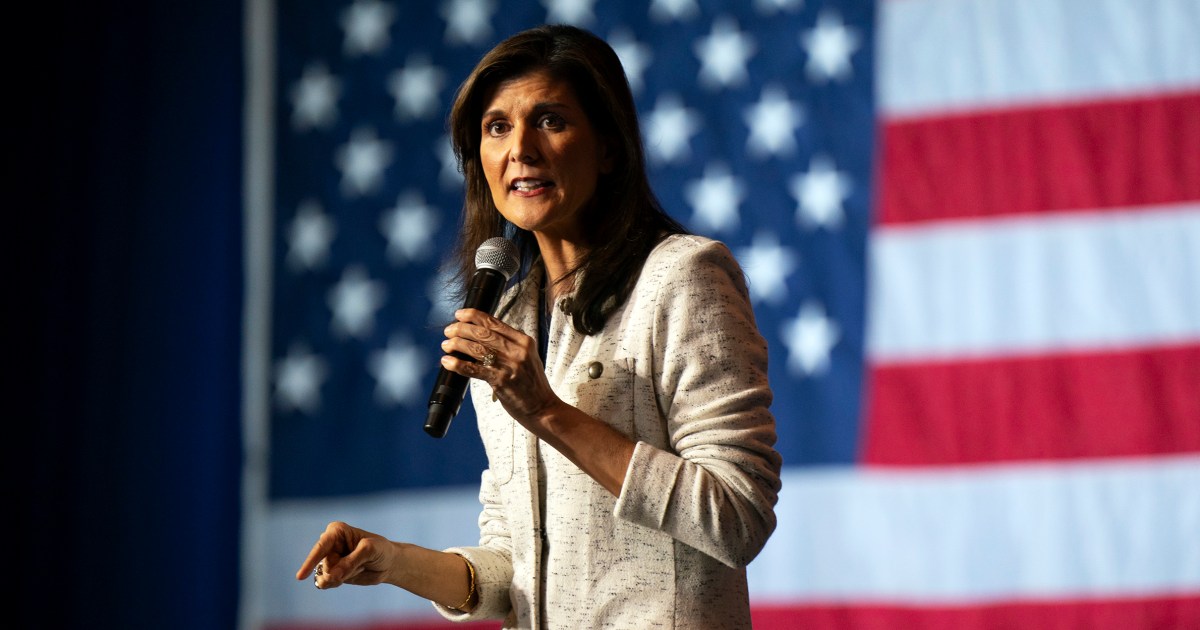
John Moniello performs during an evening of music on the Branford Green on May 26. Branford Parks & Recreation presents the Music on the Green series featuring local bands playing on Thursday evenings from 6 to 8 p.m. through June 23. The local bands set the stage for the 14th Branford Summer Jazz Series on the Green, which returns after two years with a kick-off concert set for Thursday, June 30.
The Thursday evening series of nine shows features musicians from the world of jazz and will run through Thursday, Aug. 25. All shows are free and begin at 6:30 p.m. For more information, visit www.branfordjazz.com.
Baseball on the island is all a part of one big ohana. Just ask thirty-year Little League® volunteer Gerald Oda.
“Ohana for us is family,” said Mr. Oda. “And it is not just blood family. Family is everybody. Everyone that we have a connection with. When we say you’re part of our ohana, it means that you’re part of us.”
Little League teams across the island state are hopeful to once again bring their ohana onto the mainland and make it again to the Little League World Series.
Over the years in Williamsport, Hawaii has had great success on the field. They’ve made 14 Little League Baseball® World Series Tournaments. And they’ve won three of them. The first win came in 2005, then again in 2008, and most recently in 2018.
Sean Yamaguchi was a captain of that 2018 team. Now he’s playing baseball in high school and can reflect on what it meant to represent his state. Like many from Hawaii would, he talked about making sure they played the game the way it is meant to be played: with heart, grit, and sportsmanship.
“We wanted to do it the right way – show the aloha spirit. And I think we did that well,” said Sean. “I think that everyone got the message of what we were about.”
He added that representing the state doesn’t mean more pressure.
“We just play baseball how it’s supposed to be played,” said Sean. “You know, we have fun out there. We have no pressure on us because, I mean, we have nothing to lose. We’re from Hawaii. We’re from such a small place that we can go out there and have fun.”
As great as Hawaii have been on the field, their presence is Williamsport has meant just as much off of it – to opponents, volunteers, and everyone who has watched them play the game their way.
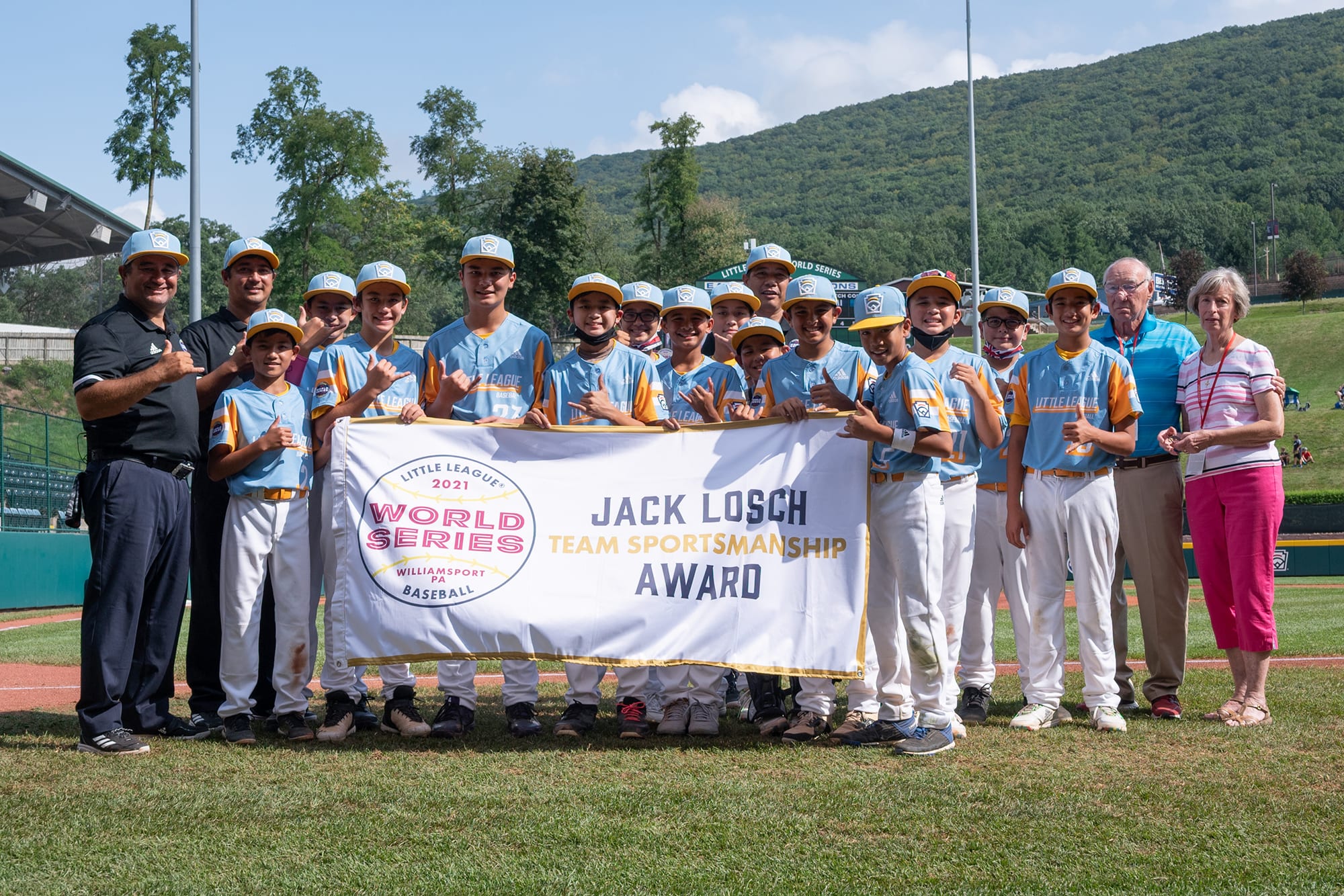
Kevin Bagoyo has seen it up close twice. The first time was as a player with Pearl City Little League in 1988, then again, he coached his son, Zack, on the 2021 team from Honolulu Little League. He says the aloha spirit is a big reason why they’ve won the Jack Losch Award twice in the last three years.
“The spirit is just showing a lot of love and kindness to anyone that we meet,” said Mr. Bagoyo. “Not only are we able to share gifts with them, but it also makes us happy as well to able to see the joy on their faces when we give them some candy or some leis and some flowers.”
Mr. Oda echoed Mr. Bagoyo and added the reason why.
“The one thing that we all do, and it’s common to Hawaii teams, is that as soon as we know we are traveling to a tournament, we bring gifts as a sign of appreciation,” said Mr. Oda. “We do this for the people that support the tournament and as a sign of appreciation for our opponent. They’re the reason we are there.”
They show that same appreciation within the team as well. Both Mr. Oda and Mr. Bagoyo spoke of how important it is to make the tournament fun for the players.
“Even among the coaches, we always remind ourselves it’s about creating positive memories for these kids,” said Mr. Oda. “And reminding them that, whether we win or lose, we really can’t control it. But we can definitely control how we perform and how we behave both on and off the field.”
Sean said that the coaching staff did a good job of instilling the island’s ideals into them. He’s taken the aloha spirit he learned growing up in Hawaii around the game of baseball and brought it forward with him.
“The aloha spirit is just being yourself, having fun on the field, off the field, making new friends,” said Sean. “And I think with the Little League World Series experience, we really got to show our aloha spirit to the whole world. And that’s what I loved about it.”
Over the years in Williamsport, Hawaii has shown the world their aloha spirit and invited all of us into their ohana.
NOTE: As the world gears up to celebrate the 75th Anniversary of the Little League Baseball® World Series (LLBWS) in August 2022, Little League® International will feature content such as this in a series of franchises that highlights some of the key moments, memories, and people that have made the LLBWS one of the most iconic sporting events in the world. For more information, visit LittleLeague.org/75.
One could imagine that, after retiring all 12 batters he faced last Saturday, Cole Henry wanted to see a 13th, then a 14th, then a 15th. Or that when the 22-year-old struck out five batters in three innings on April 10 — and again on April 22 — he may have wanted to push for double digits. Or that pitching four dominant innings at a time is making him antsy, even if the Washington Nationals explained this plan at the beginning of spring training.
The goal, put simply, is to have Henry pitch first full minor league season. After he was drafted in the second round in 2020, there were no minor league games to pitch in because of the coronavirus pandemic. Last year, elbow soreness limited him to 47 innings across 11 appearances. So now Washington is spoon-feeding him innings, feeling that’s better than giving him five- or six-inning starts only to shut him down in August.
Henry recently rested for 15 days between outings with the Class AA Harrisburg Senators. Generally viewed as the second-best pitching prospect in the Nationals’ system, Henry has a 0.76 ERA through 23⅔ innings (seven starts). He has struck out 28 batters and walked nine, mixing a four-seam fastball, sinker, curve and change-up. And if you ask around the organization about Henry and Cade Cavalli — the Nationals’ top prospect and first-round pick in 2020 — many believe that, at the moment, Henry is the more polished pitcher.
Cavalli was a two-way player until he dropped his bat as a junior at the University of Oklahoma. Henry, by contrast, started 11 games as a freshman at LSU before elbow issues kept him to four starts as a sophomore. He’s solely focused on pitching for longer than Cavalli, intriguing members of Washington’s front office and evaluators from other teams. Yet a key difference is that while Cavalli’s with the Class AAA Rochester Red Wings, knocking for a chance, Henry’s being inched along. Cavalli, 23, is a year older and pushed ahead by throwing 123 1/3 innings in 2021.
“We’ve had guys who have been on innings limits in the past, and it’s crazy that when you put a number on a guy it really comes up faster than you would think just through the normal starts," minor league pitching coordinator Sam Narron said. " So we want Cole to be able to finish the year and make all of his starts. It’s going to be a gradual progression, building him through the end of the year where he can continue to pitch finish the year as opposed to maybe having to stop him at a certain point because he has run out of innings.
"So we want to be judicious early so that he can be strong late.”
After last summer, Henry went to the Arizona Fall League and impressed against top prospects from around the league. But because of the plan to measure out his innings, the Nationals chose to not put Henry in major league camp for a second straight spring. Meanwhile, Cavalli and Jackson Rutledge, another young righty, had lockers near catchers Keibert Ruiz and Riley Adams. Without proper context, it seemed as if Henry had fallen behind.
That was far from the case, though. The decision was rooted more in the Nationals’ interest in Henry than some loose pecking order. Rutledge, 23 and slowed by injuries again, is trying to find his rhythm with the low-Class A Fredericksburg Nationals. Cavalli threw seven scoreless innings against the Syracuse Chiefs on Saturday, further burying a blowup on May 17. And Henry sits between them, staying patient with his carefully plotted workload.
None of Henry’s seven starts have exceeded four innings. On May 5, he walked five batters, his worth showing of the year, and was hooked after 2 2/3. But it is still worth noting that, until his command slipped, he had pitched 13 innings and not allowed a run. Henry’s 15-day layoff included some throwing and a good bit of rest. The Nationals are considering a similar break for 25-year-old righty Jake Irvin, who is coming off Tommy John surgery and has a 1.73 ERA in 26 innings for Harrisburg.
“You’re up front with the kid because they want to make it to the major leagues and make an impact,” Narron said. “When those competitive juices get going, of course Cole wants to pitch. We want that. But back in spring we told him, ‘Look, there are going to be starts that are shorter than you want. Trust us. This is for your benefit in the long run.’ ”
Some other updates from the Nationals’ system:
Sammy Infante: The 20-year-old infielder leads the low-A Carolina League with 12 homers through 35 games. The next closest players entered Tuesday with seven. And while his 6-foot-1, 185-pound frame doesn’t scream power, his peripheral statistics suggest this pop isn’t a total mirage. Infante has also found a defensive home in the early going, playing third while top prospect Brady House fills shortstop for Fredericksburg. Infante was drafted as a shortstop in the second round of the 2020 draft. But Washington likes to select middle infielder and then moved them around the diamond, which always seemed possible for Infante.
Jackson Cluff: After shining defensively at the Arizona Fall League in November, Cluff is struggling at the plate for Harrisburg, entering Tuesday with a batting average/on-base percentage/slugging percentage slash line of .142/.208/.225. Batting lefty, Cluff is just 2 for 23 with 11 strikeouts against left-handed pitchers. The Nationals invited the 25-year-old to major league camp this spring, liking his glove and strong arm up the middle. But he has to have a sharp turnaround at the plate to get in their rebuild plans.
Left-handed relievers: Ike Schlabach and Jose Ferrer each earned promotions at the end of last week. Schlabach, 25, went from the high-A Wilmington Blue Rocks to Harrisburg, replacing lefty reliever Matt Cronin after he was bumped to Rochester. Ferrer moved from Fredericksburg to Wilmington, filling Schlabach’s spot. Schlabach, originally drafted by the Pittsburgh Pirates, yielded two earned runs and had a solid strikeout rate in 16 2/3 innings with Wilmington. Ferrer, signed by Washington out of the Dominican Republic in 2017, struck out 11.25 batters per nine innings with Fredericksburg (logging 20 innings, only one walk and home run allowed). His fastball is sitting in the mid-90s and has jumped to 98/99.
(CNN)The context is more important than the content in "Norm Macdonald: Nothing Special," a spare one-man comedy show that the former "Weekend Update" anchor, knowing that he was ill, wrote and performed in a single take at home alone before his death in September. The posthumous release provides a fitting and deeply personal tribute, as well as a primer on the art of stand-up.
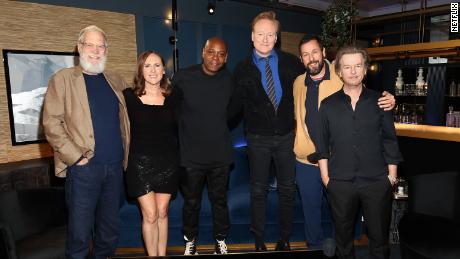
Netflix has packaged Macdonald's performance, which runs a little over 50 minutes, with a half-hour discussion featuring six of his friends: Dave Chappelle, David Letterman, Adam Sandler, David Spade, Conan O'Brien, and Molly Shannon, who spend another 30 minutes or so reminiscing about him while deconstructing what viewers just saw.
Chappelle calls the stark setting "very endearing," while Letterman notes that without an audience to respond to the material, "We weren't watching standup comedy. Without that audience, you don't get the full measure of Norm."
What you do get is a clear reminder of Macdonald's quirky sense of humor as he flits from topic to topic, occasionally engages in odd digressions and endures the kind of interruptions that have been common to work experiences during Covid, from his dog barking to answering a phone call and saying sorry, but he's in the middle of taping a comedy special.
While Macdonald knew his time might be short, there's nothing morbid or maudlin about the presentation, which essentially trains a camera on his face and lets him rip. The comic does mention living wills and a few other matters that touch upon mortality, but it's no different in tone than his routine about preferring to gamble at Native-American casinos ("I look on it as a form of reparations") or strategizing about cannibalism should he ever be on a plane that crashes in the Andes.
David Letterman, Molly Shannon, Dave Chappelle, Conan O'Brien, Adam Sandler, David Spade discuss Norm Macdonald in a segment filmed at the Netflix Is A Joke festival.
Like the controversies surrounding Netflix's recent specials involving high-profile comics (the aforementioned Chappelle and more recently Ricky Gervais among them), Macdonald chafes against restrictions on what's presently considered permissible for comedians to say and references how "Words have changed" in terms of what might cause offense. If that has become a kind of generational rift and ongoing debate, Macdonald seemingly wanted to let the world know where he stood.
Beyond that, Macdonald's performance and the ensuing conversation/analysis (taped during Netflix's recent Netflix Is a Joke comedy showcase) benefit from a relaxed quality, taking viewers behind the curtain where they can listen in on comics' process and thoughts.
Macdonald mentions missing the thrill of being able to perform live, but there's a comforting sense that he's well aware he's both doing something he loves and, for the last time, doing it both on a big stage and his own terms. As his producing partner, Lori Jo Hoekstra, described it, "He left this gift for all of us."
However one responds to the various jokes, there's something more sweet than sad about that. Macdonald is gone, but he was able to orchestrate his own curtain call, saying goodbye with a little help from his friends.
"Norm Macdonald: Nothing Special" premieres May 30 on Netflix.
Government support eases sanctions pressure for now
Minister sees 'demand crisis' as spending plunges
Military campaign in Ukraine demands 'huge resources'
Economists see bleak long-term outlook for Russian economy
LONDON, May 30 (Reuters) - For Oleg Kechin, owner of a chain of barbershops, forecasts that Russia will be plunged into its deepest economic crisis in a generation feel overdone.
U.S. President Joe Biden may have promised that Western sanctions would wreak economic havoc in Russia, but Kechin's business is still drawing in customers in the town of Saransk, which lies 510 km (320 miles) southeast of Moscow.
"There's no deep crisis. In general, everything's fine," he said. "Everyone's talking about a decrease in purchasing power, but I haven't noticed it."
Register now for FREE unlimited access to Reuters.com
Yet, such confidence may not be entirely well placed, if some indicators are to be believed. Trade with the outside world has plunged, consumers are reluctant to spend and rising prices on basic items are starting to squeeze household budgets.
Russian officials insist the economy is holding up. The central bank slashed interest rates by three percentage points to 11% on Thursday and expects to cut its forecast for inflation for this year from the current prediction of 18-23%.
Under capital controls and orders that exporters sell half their hard currency earnings, the rouble has rallied and, at about 66 to the U.S. dollar , is stronger than before Russia sent its armed forces into Ukraine on Feb. 24.
President Vladimir Putin, who has welcomed the departure of foreign firms which have sold up or just dumped Russian assets, said Russia could not be isolated from global trade.
But not everyone is convinced the economy will escape unscathed. Roman, a 25-year-old in Moscow, who asked not to be identified by his full name, said middle class life was not "drastically different" than before but he saw worrying signs.
"One thing that bothers me ... is constant price rises for everyday goods and even vegetables. I think that signals the worst is yet to come." he said. "The situation with the labour market in my sphere doesn't make me very optimistic either."
'DEMAND CRISIS'
Some indicators justify his concerns. VAT receipts, which reflect consumer spending, fell 54% in April year on year, the Kommersant daily said, citing preliminary finance ministry data.
Economy Minister Maxim Reshetnikov said on Friday there was a "demand crisis" in business and consumer spending.
Russia has stopped publishing most data on financial flows, but figures compiled by the Bank of Finland based on local customs data show imports have plunged - and not just from the West.
Chinese exports to Russia were down by a quarter in April and shipments from Vietnam, South Korea, Malaysia and Taiwan more than halved, the bank said.
The economy minister said manufacturers were re-establishing supply chains broken by sanctions and said 2,000 "backbone companies" could access preferential lending programmes.
But inflation is still at its highest in two decades at more than 17%. That means a 10% hike in pensions and the minimum wage announced by Putin still leaves many facing a cut in household incomes in real terms.
Rising prices may not be Russia's biggest problem. The strong rouble has already brought down weekly inflation sharply, but it won't fend off a broader threat to economic output from Russia's increasing isolation.
Reshetnikov said there were "fears that we could break into a deflationary spiral, when a reduction in money in the economy leads to a reduction in production, lower prices, and so on."
Meanwhile, financing a military campaign in Ukraine will put pressure on the budget. Finance Minister Anton Siluanov said on Friday that Moscow required "huge financial resources" for what Moscow calls its "special military operation". read more
STIMULUS
Russia has already dipped into its National Wealth Fund, which has about $110 billion of liquid assets, to support spending, which is up 22% this year, the economy minister said.
The finance minister said Moscow had earmarked 8 trillion roubles ($123 billion) of stimulus for "the current circumstances", although it was not clear how much of that was new money and over what period.
The full impact on economic output and jobs from the withdrawal of Western firms, ranging from carmakers to banks, has yet to seen.
Sergei Guriev, economics professor at France's Sciences Po, expected the impact to be felt more sharply in the next few months.
"The real pain has not started yet as some exiting companies are still paying wages and some companies continue production using their inventories of imported parts," said Guriev, who is also a former chief economist at the European Bank for Reconstruction and Development.
Morgan Stanley economists see a 13% drop in household consumption in 2022 and a 23% fall in investment. The bank's chief regional economist, Alina Slyusarchuk, said in a note that Russia's potential long-term growth rate was now just 1%.
The outlook appears to be dimming for smaller Russian firms, although there is little way to gauge it precisely with so little official data now being published and businesses no longer required to report results.
"Very few companies want to create a strategy or plan long-term, large-scale contracts right now," said Anastasia Kiseleva, a partner at a small public relations firm in Moscow.
"Businesses - especially small ones - will be engaged in pure survival, not developing or creating anything new."
Survival-mode, however, is nothing new to many Russians, who have lived through several deep crises since the collapse of the Soviet Union in 1991.
"The worst is ahead of us," said Yevgeniy Sheremetov, who runs a tour company near Lake Baikal in Siberia. "But residents of this country are used to difficulties. I have my summer house, with potatoes and cucumbers. After the 1990s, nothing can scare me."
Register now for FREE unlimited access to Reuters.com
Additional reporting by Marc Jones in London; Editing by Kevin Liffey and Edmund Blair



/cloudfront-us-east-2.images.arcpublishing.com/reuters/RFFBVL6QE5PNZIB2XWM63CVSQE.jpg)